
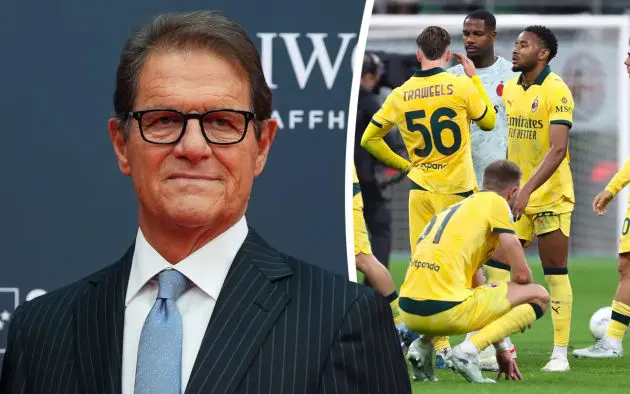
Fabio Capello believes that AC Milan’s drop-off was something he could see coming, while he accused some players of not caring.
Read SempreMilan ad-free and get access to exclusive news. Click here for a free trial!
The last couple of months could have gone better for Milan. They have won just two of their last eight games and have seen an eight-point gap over fifth place completely wiped out, which has set up a far more tense season finale than what Massimiliano Allegri would have hoped for.
While the attack continues to struggle to score goals, the defensive solidity seems to have abandoned the team too with five goals conceded in the last two matches. With Genoa and Cagliari to come, the Rossoneri need two wins to secure Champions League football and avoid completing the collapse.
Capello spoke to La Gazzetta dello Sport about the decline that Milan have had in recent weeks and why it was predictable in his eyes, despite all of the positivity from the first half of the 2025-26 campaign.
A decline at the end of the season is understandable, but would anyone have expected such a collapse?
“The reality is that in the last four games, Milan hasn’t been strong, hasn’t fought, hasn’t shown the desire and determination needed to win. And the results are there to see. None of this surprises me.”
Is there any particular situation you’re referring to?
“Certainly. I saw some players fighting and others losing the ball and not caring. Players who didn’t care about helping and weren’t interested in lending a hand in defence.”
How do they get out of this pit?
“In terms of play, I’d like to see a solid team again, something that hasn’t happened since. But above all, the Milan of the last two games must be the same as they were in the final half hour against Atalanta: a team eager, angry, and determined.
“I hear that Atalanta facilitated the situation by dropping too much, but if that happened, it was down to Milan. If the Rossoneri start from this foundation, the results will come. But the ninety minutes must be played entirely like this, and not just in reaction to protests or boos.
“Frankly, I don’t think the coach didn’t work on this aspect. On the pitch, however, the team showed a disjointed spirit among the players. There’s not much to talk about now, or rather: Allegri must make one thing clear in the dressing room.”
Which?
“Whatever prompted you to play that way in the last twenty minutes against Atalanta, now you have to do it for the entire ninety. Was it anger? Show me that throughout the match.”
More than a few have pointed the finger at a poor physical condition…
“No way, it’s not a physical problem. If they start running like crazy in the 80th minute, the explanation doesn’t hold up.”
So, as Allegri says, it’s all in the mind?
“Certainly. If the team believes it can play like it did in the last game against Atalanta, the two wins we need will come.”
But now the defence are also declining…
“They’re playing poorly at the back because they’re inattentive and because there’s no filter in midfield. I haven’t seen Milan attack when the opponent has the ball anymore. Before, they closed down, even when they were defending.”
Moreover, the defenders are the same as in the months when not even a pin could pass behind them…
“It’s a question of teamwork, and then there was a lack of desire and determination from the entire team.”
How much blame does Allegri have in a similar context?
“Looking at the negative numbers, he obviously has some blame. He failed to keep his mental health high. However, he’s been talking about reaching a certain score for some time, giving precise instructions and a clear message.
“He’s evidently been sensing something wrong with the team for quite some time. He was sniffing the air, I think.”
How much are the players to blame?
“The coach doesn’t go on the pitch, he just gives instructions. If a player loses the ball and then doesn’t move to get it back… that’s the gist of it.”
What is the most glaring weakness of this team?
“They don’t score goals, that’s easy to say. Leao has scored nine in the league, but he can’t play like that up front. It’s reductive to blame him all the time; everyone’s to blame.”
Some are calling for a complete reset at all levels: would that be the best solution?
“These are things I read and hear, I don’t know. Only those who experience the situation from the inside can know. I can only say that the blame must be shared.
“I mean, the blame lies with the managers, who by definition are those who lead. And then, in a cascade, it trickles down the organizational chart. Also because at Milan, no one person makes decisions alone.”