
The signs from the first two days of Ruben Amorim’s work at Milanello suggest a very different approach from that of his predecessor.
Read SempreMilan ad-free and get access to exclusive news. Click here for a free trial!
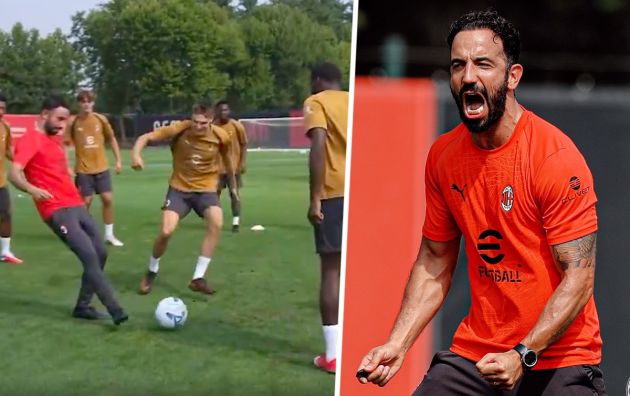
La Gazzetta dello Sport report that Amorim wants to be at the heart of Milan, figuratively and physically. During the first training session of the season on Monday afternoon, he stood in the middle of the pitch, his old position as a player. He instinctively looked for the ball, stealing it from Mario Gila.
In a video, he can be seen participating in a rondo with unparalleled enthusiasm. It is partly joking of course, but partly a genuine desire to participate. Seeing him up close, you get the impression of a man searching for the joy of coaching, for that fire within himself that Manchester United took away.
Building a bond
Massimiliano Allegri entrusted much of the training to his very large staff, which was expanded for his arrival last summer, and he only intervened at specific times. Amorim, however, has a much smaller staff and often interjects personally.
Allegri spoke to the team in Italian, while Amorim speaks in English as he learns the language. He gave a short speech to the team, remained close to the players, and spent time discussing matters, especially with Gila.
The impression is that he wants to establish a familiar yet direct and sincere relationship with the players. “Whatever you need, I’m here, I’m available,” he said in his pre-training speech. “I’ll defend you in any argument, if you’re right.”
The key words are ‘if you’re right’ and not regardless. Allegri might not have said so. Amorim didn’t focus particularly on young players on his first day, but he will soon, and he’ll certainly give some a chance, as Allegri did with Davide Bartesaghi.
On the pitch, a clear direction was evident, though it would be absurd to draw conclusions after two or three training sessions. Amorim has the team play a 3-4-2-1 formation, works on ball circulation, constantly uses the ball, and asks for a restart from the back if a drill isn’t working.
In the first tactical drill he alternated two teams, coming in and out to give the players a rest and create a rhythm in the training. He will soon structure the pressing mechanisms, another key cornerstone of his project. If it’s a winning Milan remains to be seen, but it is certainly different.