
AC Milan’s third preseason friendly of the summer from a result standpoint did not go to plan, as they were comfortably beaten by Chelsea.
Read SempreMilan ad-free and get access to exclusive news. Click here for a free trial!
Milan competed for 45 minutes at the Gelora Bung Karno Stadium in Jakarta, with an experimental side again. However, a João Pedro double just before and just after half-time plus a goal from Moises Caicedo meant that Xabi Alonso’s side ran out easy winners.
It could have been a wider margin of victory in truth but Lorenzo Torriani stood tall at times to keep things relatively respectably. At the other end, Ruben Amorim’s men failed to register a single shot on target, which is a cause for concern.
Now, the Rossoneri will be back in action on Saturday 15 August in Wrocław, Poland, for their final test before the start of their competitive campaign. Rohit Rajeev has some tactical takeaways from the Chelsea defeat.
Build-up shape
As we saw against Inter, Milan are comfortable baiting the opposition press. Modrić drops deeper, deliberately drawing his marker towards him and creating a gap between Chelsea’s midfield and defensive lines.
Torriani then exploits this space with chipped passes over the press, allowing Milan to bypass Chelsea’s first line and progress the ball. It was a clever mechanism to manipulate the opposition press and create space in behind.
🔴⚫ As we saw against Inter, Milan are comfortable baiting the opposition press.
🧠 Modrić drops deeper, deliberately drawing his marker towards him and creating a gap between Chelsea’s midfield and defensive lines.
🎯 Torriani then exploits this space with chipped passes over… pic.twitter.com/GG1WLixgdG
— Rohit Rajeev (@keralista) August 10, 2026
Milan’s build up structure was designed to combat Chelsea’s 2+2 pressing structure. When playing out from the back, the two outside centre backs stay deep and wide, while the central centre back steps into midfield to create an extra player in the first phase.
This gives Milan an additional passing option and helps them play around Chelsea’s first line of pressure.
Loftus-Cheek then drops into midfield to create a third man combination, giving Milan another way to progress through the press. A well designed structure to create numerical and positional advantages in the build up.
🔴⚫ Milan’s build up structure was designed to combat Chelsea’s 2+2 pressing structure.
📐 When playing out from the back, the two outside centre backs stay deep and wide, while the central centre back steps into midfield to create an extra player in the first phase.
🧠 This… pic.twitter.com/FEKTTmoINE
— Rohit Rajeev (@keralista) August 10, 2026
High line and marking
Milan are playing with a high defensive line, which will inevitably leave space in behind. The key issue is that even teams sitting in a deep block will look to exploit that space.
Once Milan lose possession, opponents can quickly attack the space behind the defensive line with direct passes and runs in behind.
A high line can be effective, but Milan need to manage the depth much better to avoid being exposed in transition.

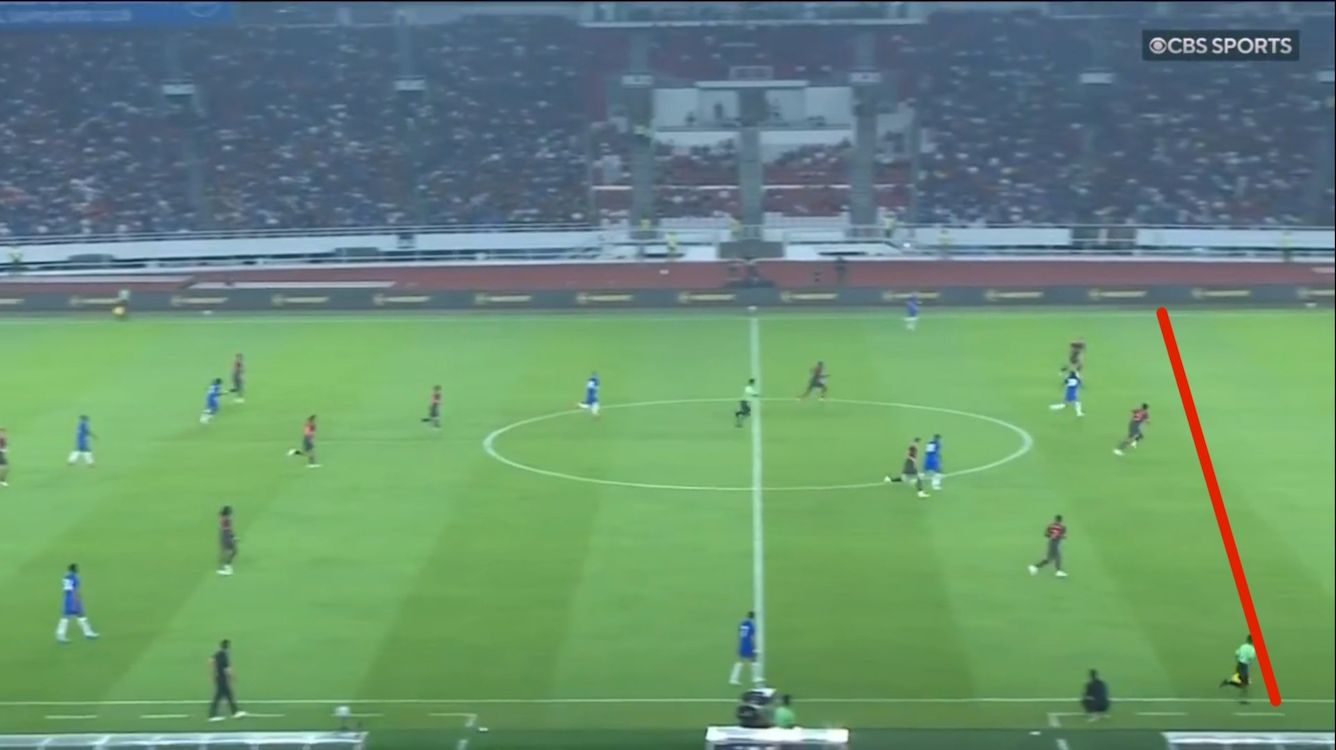
Milan use a hybrid marking system, but Chelsea find a way to exploit it. Chelsea overload the near post before Caicedo delivers the cross.
The Chelsea players make deceptive runs towards the near post, dragging Milan’s markers with them and creating separation between the Milan defender and Torriani.
João Pedro then attacks the space that has been created and finishes. A clever attacking routine that exposes the vulnerabilities of Milan’s hybrid marking system.
🔴⚫ Milan use a hybrid marking system, but Chelsea find a way to exploit it.
🎯 Chelsea overload the near post before Caicedo delivers the cross.
🧠 The Chelsea players make deceptive runs towards the near post, dragging Milan’s markers with them and creating separation… pic.twitter.com/5sJKkUb1O8
— Rohit Rajeev (@keralista) August 10, 2026
Improvements and concerns
Milan’s press improved significantly in the second half. Nkunku and Ramos intelligently pressed Chelsea’s two central passing options, forcing the ball wide.
Milan then boxed Chelsea into the wide area, limiting their options and making progression difficult. With no easy pass available, the Chelsea player was forced to attempt an audacious chipped pass.
The pass fails and Milan regain possession. This is what an effective pressing structure looks like: restrict the options, trap the opponent and force the mistake.
📈 Milan’s press improved significantly in the second half.
🔥 Nkunku and Ramos intelligently pressed Chelsea’s two central passing options, forcing the ball wide.
🔒 Milan then boxed Chelsea into the wide area, limiting their options and making progression difficult.
🎯 With… pic.twitter.com/F9jj2jg0wK
— Rohit Rajeev (@keralista) August 10, 2026
João Pedro’s second goal highlights another defensive issue for Milan. Terracciano becomes ball watching instead of scanning for his potential marker.
João Pedro recognises this immediately and calmly moves into the space between the Milan defenders. Once the pass arrives, he coolly slots the ball home.
At this level, losing sight of your opponent for even a second can be enough to concede.
⚠️ João Pedro’s second goal highlights another defensive issue for Milan.
👀 Terracciano becomes ball watching instead of scanning for his potential marker.
🧠 João Pedro recognises this immediately and calmly moves into the space between the Milan defenders.
🎯 Once the pass… pic.twitter.com/eduoKtFzZc
— Rohit Rajeev (@keralista) August 10, 2026
In July we published an analysis of why Leao is certainly not a hand-in-glove fit for Amorim’s system and style. We saw issues on the left side in the Chelsea game off the ball.
“If Milan commit numbers forward and maintain a high line, they’ll naturally become vulnerable to counter-attacks, especially in the space between the left-sided midfielder and the left winger.
“That means the left winger must consistently track back, cover large distances, or apply immediate counter-pressure to stop transitions before they develop.”
Here is an example of exactly that. Leao and Estupinan attack and this leaves huge gaps on the left side. It will be quite a problem for Amorim to figure out.
Here is an example of exactly what I said:
Leao and Estupinan attack and this leaves huge gaps on the left side. It will be quite a problem for Amorim to figure out. https://t.co/plokDE1yOS pic.twitter.com/I5Hwck22qn
— Rohit Rajeev (@keralista) August 10, 2026
Staggered pivot
Comotto and Modrić operated as a staggered double pivot, giving Milan flexibility in their build up. Their positioning created various passing combinations, allowing Milan to constantly adjust their angles and offer different options to progress the ball.

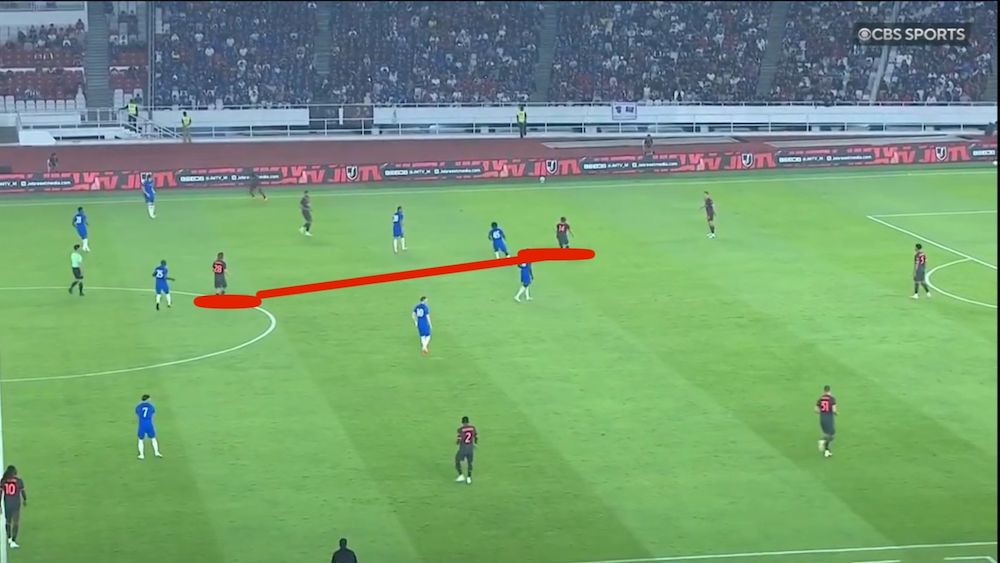
The staggered structure also helped create different heights in midfield, making it harder for Chelsea to press both players simultaneously.