
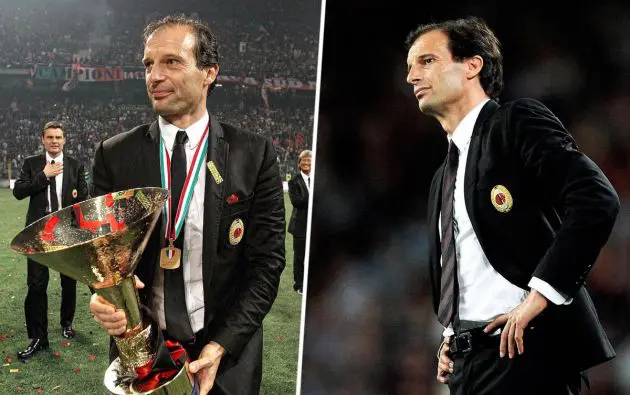
In a move to make amends following an unequivocally disappointing season, AC Milan have swiftly confirmed the return of Massimiliano Allegri as head coach, marking his second spell in charge of the Rossoneri.
Read SempreMilan ad-free and get access to exclusive news. Click here for a free trial!
Allegri becomes the fourth man to occupy the Milan bench in just 12 months, denoting a level of managerial instability that’s ironic for a club driven by financial caution and sustainability. This was not the kind of ‘turnover’ Milan’s management, led by Giorgio Furlani, had envisioned.
The appointment raises more questions than answers. Allegri, nearly 58, returns to a very different Milan than the one he led to a Scudetto in 2010-11. That team boasted elite defenders and a seasoned Zlatan Ibrahimović in his prime.
This current version is riddled with gaps, especially in defence and attack, posing immediate challenges for a coach whose system thrives on discipline, defensive solidity and graft from forwards.

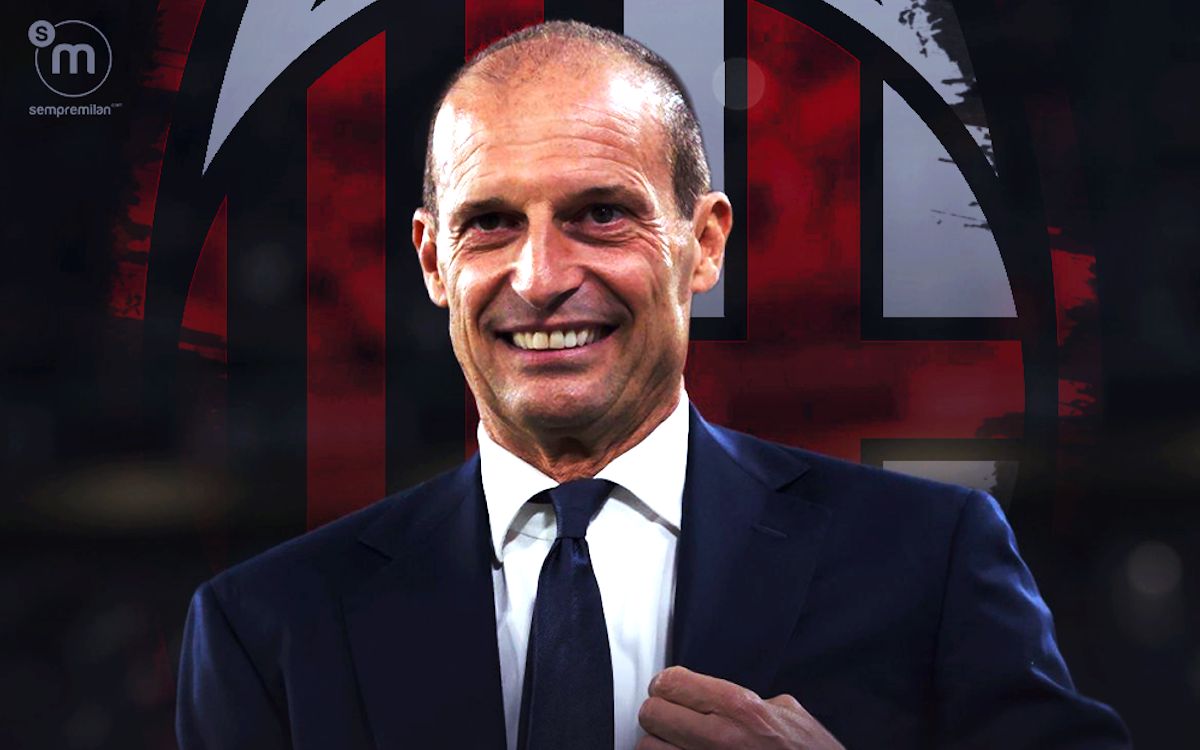
Substance over style
Allegri is often labelled a pragmatist. He’s not aligned to any tactical ideology but prefers structure, balance, and minimalism. He builds from the back, ensures his midfield is compact, and leans on the individual brilliance of creative players rather than systemic chance creation.
Ironically, Milan are in the process of selling their most prominent playmaker – Tijjani Reijnders – and currently, an adequate replacement is missing from renowned sources and gossip columns. Expecting Allegri to compensate for this loss through tactical wizardry may be wishful thinking; his style isn’t tailored to entertain or create without the right personnel.
Reports suggest Allegri has been offered a bonus if he finishes in the top four. Given that Milan will be playing once a week next season, without the demands of European football, this goal seems modest, even meek.
A club of Milan’s stature, provided with the opportunity at hand, should aim higher. Aided by a comfortable schedule, anything less than a genuine title challenge should be viewed as underachievement.
But perhaps the most alarming aspect of Allegri’s recent track record lies in his work with strikers. At Juventus, Dusan Vlahović – a €70m signing – regressed alarmingly under Allegri’s stewardship. There’s a real fear that a similar fate could await Santiago Giménez, Milan’s marquee January acquisition.

The Mexican forward arrived with much fanfare, but if Allegri cannot evolve his approach, Milan’s attacking potential could suffer much like the Serbian centre-forward.
Allegri’s recent history in Europe is also underwhelming. His Juventus side exited the Champions League group stage in 2022–23 and were ousted by Villarreal in 2021–22. These performances portray a coach whose methods had lost their edge on the continental stage.
Domestically, his record isn’t much better. Since rejoining Juventus in 2021, Allegri averaged just 1.84 points per match. Over the past three seasons, that tally would place his team fourth in each of the seasons, which hardly represents a winning mentality.
His lone piece of silverware in his second Juve stint was the 2023–24 Coppa Italia. A respectable achievement that may be, but underwhelming for a man once considered among Europe’s elite.
Many now argue that Allegri is surviving on reputation alone, a shell of the tactical force he was from 2015 to 2017. His football has not aged well, and he remains stubbornly wedded to conservative principles. In modern football, where fluidity and dynamism reign, Allegri’s stodgy brand of play feels outdated.

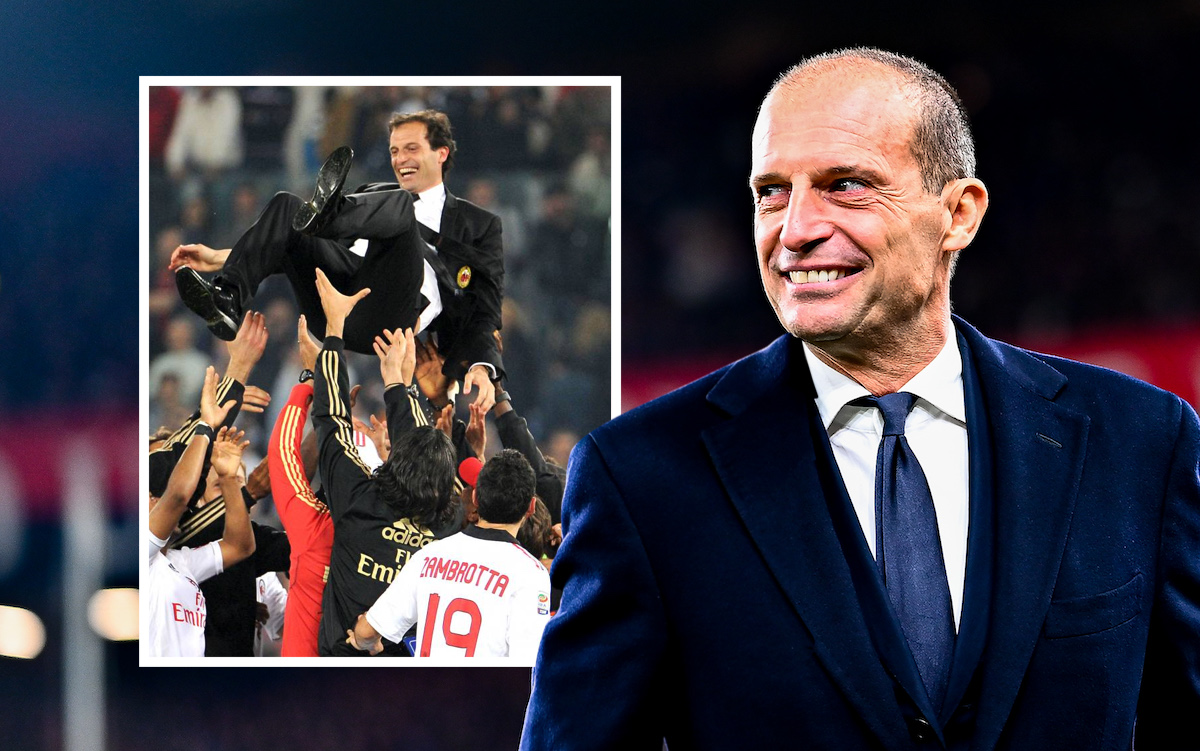
A known quantity
For Milan, this appointment feels less like a bold step forward and more like a step backward in search of stability. That said, Allegri does offer something his predecessor could not: predictability and experience. Sergio Conceição’s brief tenure was chaotic.
The former Porto boss never quite adapted to Serie A’s tactical demands or the relentless scrutiny of Italian media. Playing the victim more often than the strategist, he came across as a caricature of Antonio Conte or José Mourinho, minus the results or gravitas.
Conceição left Milan with an underwhelming points-per-match record of 1.71, lower than even Paulo Fonseca’s much-maligned spell. His teams lacked inspiration, relying on rigid defensive structures and sporadic counter-attacks.
The UEFA Champions League blunder against Feyenoord and a baffling collapse in the Coppa Italia final against Bologna – just days after routing the same side – highlighted the inconsistencies that plagued his reign.
In that context, Milan’s decision to act early and decisively is commendable. The appointment of a seasoned sporting director in Igli Tare, alongside Allegri, signals a desire to lay solid foundations well before the 2025–26 season begins.
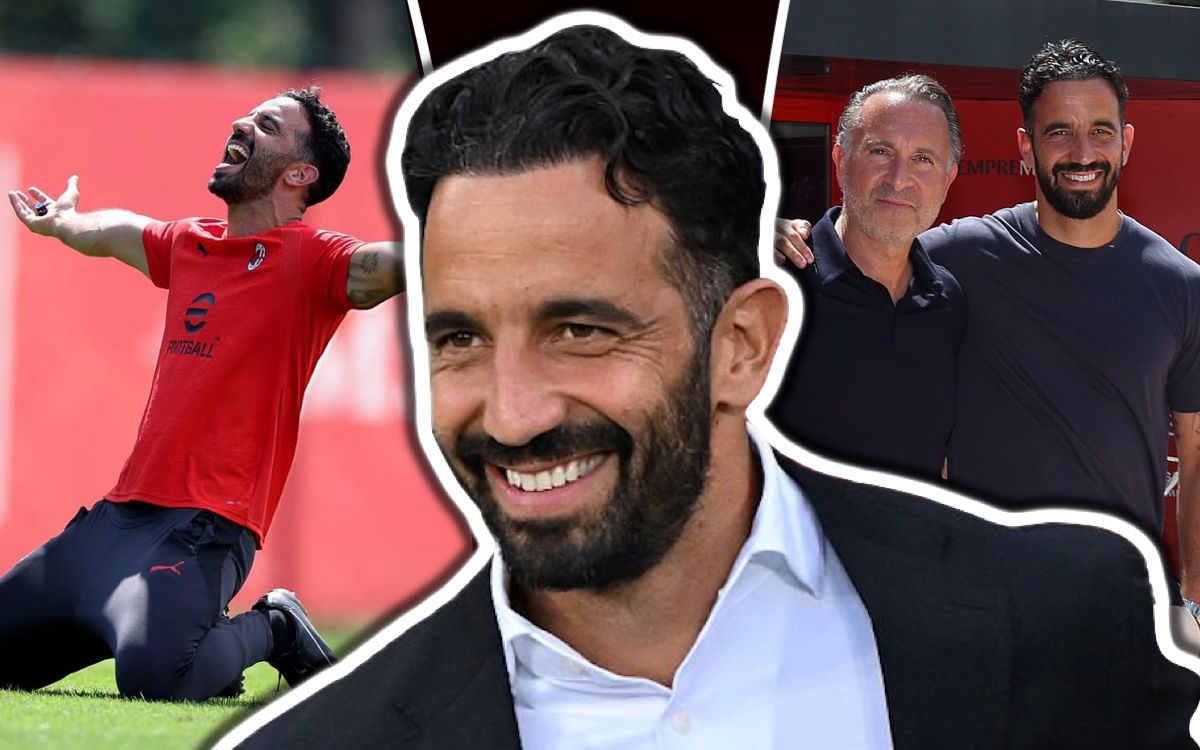
This proactive approach offers time for squad assessments, preseason planning, and potential reinforcements. However, good administration doesn’t always translate into trophies.
Furlani has spoken of a “reset,” a strategic pivot back toward domestic stability. Choosing Allegri over a more experimental or ‘hipster’ candidate fits that narrative. He is safe, proven, and theoretically dependable. But Milan fans have seen this movie before.
The club’s 19th Scudetto came under Stefano Pioli, a manager who reimagined his methods and embraced risk. The 18th, back in 2011, was Allegri’s masterpiece. Can he write another chapter of glory, or is this merely a nostalgia-fueled rerun?
Ultimately, how high Milan fly depends on Allegri’s ability to defy time, rethink his ideas, and adapt to a squad that may not suit his preferred style. Without world-class defenders or tireless attackers, his margin for error is razor-thin.
Unless he reinvents himself, or the club commits to supplying players that fit his structure, Allegri risks becoming emblematic of a club stuck between past success and future uncertainty.
Whether this reunion brings redemption or regret remains to be seen. One thing is clear: Milan’s bold new era begins with a name from the past, hoping lightning strikes twice.