
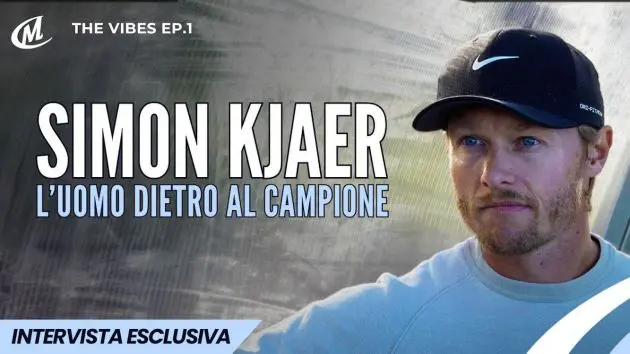
Simon Kjaer was one of the key players to AC Milan’s Scudetto in the 2021/22 season and he has revisited that season and more recently.
Read SempreMilan ad-free and get access to exclusive news. Click here for a free trial!
When it comes to the Scudetto-winning team, Kjaer often goes under the radar. The Theo Hernandez, the Rafael Leaos, and the Sandro Tonalis are at the forefront. However, we cannot forget Kjaer.
His season was halted in December, when he tore his ACL and he did not play another minute for the club that season, having played more than 800 in the first 15 games. Indeed, it was that same injury which probably ended his career at the top level.
He lost momentum and in your 30s, it is difficult to regain it after such a substantial injury.
Kjaer recalls Milan journey
Despite that injury, he still remains fond of the season and the fact that he achieved a dream with the Rossoneri, as he told MilanVibes in a lengthy interview last night.
“Winning the Scudetto? It gives me chills. It was one of the best days of my life, emotions that will stay with me forever. AC Milan was a dream, the Scudetto was a dream.”
The dream of becoming a footballer…
“I grew up with a passion for football: I started at four, took a short break, and started again at six. I had fun, then it became a dream; football was my first love, after my mom and dad.
“I didn’t want to do homework; I wanted to be a footballer, a dream that allowed me to find all the positive things in my life. It was better when it was just a dream, then pressure comes along and it becomes less beautiful.
“Pressure becomes a habit, but if you lose a derby in Turkey, Fenerbahce-Galatasaray, you wouldn’t leave the house. In Milan, the derby was more relaxed, but it was still a lot of pressure; you might not even leave the house. Pressure is a factor that weighs heavily in football.”
The pressure of the footballer…
“The pressure always increases as you get younger, but kids should always have fun. 99% of people who start playing football train hard, and you can only do it if you’re having fun.
“My kids aren’t Lamine Yamals; if they were to become footballers, it means they’ve put in a little effort, especially at 14 or 15. My father raised me on this combination of training and having fun, and that’s how I grew up, and that’s what it’s all about.”
The importance of family for a footballer…
“Family is everything to me, even in football: everything starts with family. Respect, a desire to work, a desire to be a teammate. My sons play defence. My job wasn’t to score goals, but my sons are just as stubborn as I am; they want to score goals every now and then.
“I’m less harsh than my father in giving advice. If they ask me, I advise them and lead them in a different direction than what they’re doing. What they’re doing now is the fruit of their hard work. They’re two central defenders, one left-footed.
“Dad was my idol. My kids are 10 and 12, so it only gets worse as the years go by (laughs). Their life journey also depends on the fact that they won’t listen to me at this age. I stopped because I wanted to spend more time with them, since in football you’re almost never at home.
“When I set the record for most appearances for the national team, my coach said I’d spent at least two and a half years with the national team. That’s when I realised it was a good part of my son’s life and I had to make up for that time.”
His journey as a footballer and his message to young people…
“When I was 15 and Midtjylland started their academy, I wasn’t chosen. I joined because three kids said no. The coaches, of which there were 15, had to write down the names of three kids who would make it to the first team, and my name wasn’t on it.
“The following year, it was on everyone’s list. This is because it’s different for everyone. There comes a point when you go from having fun to having to work towards that goal, and some might even consider giving up. But what matters at that age, theirs, is having fun.



“I was afraid that when they were 15, they’d feel pressured by their dad. It’s very important to me that they started playing not because their dad did it, but because they wanted to. I see it now, that when we go to a match, people say their dad played for AC Milan, but I’ll never put that pressure on them.”
What can Simon Kjaer teach us?
“I think the pressure to win, which starts early, is a barrier to developing talent. My advice is to have no regrets: when you go out on the pitch, you have to give it your all and not think about anything. What I experienced in the final part of my career was fun and joy at the highest level: I knew I’d given everything I had in training.
“When I went to San Siro, I’d win or lose, but I was at home happy because I knew I’d given my all all week, giving it my all. It gives you the opportunity to feel satisfied by staying on the pitch: my hope is that the boys can get to this point through a journey; I got there at 29 years old.
Now you’re the manager of Midtjylland, how does everything change?
“Midtjylland is the first club to open an academy in Denmark, and they’ve made incredible progress in 25 years. A few years ago, they built a sports center with a school for children aged 6 to 13, and they eat together with the first team, in the same building.
“They work with a human approach, thinking about the person first and then the player. The new owners have invested heavily in the training center, school, pitches, and facilities that demonstrate their desire to grow and innovate to improve as a club.
“If you stand still, you make mistakes, and that’s why I love working here.
Examples to give to the younger ones: Maldini, Ibrahimovic, Eriksen…
“Paolo Maldini as a person comes first: you have to be in close contact with a human being every day, so I always choose him as an example to bring to an event like this [the Franco Chignoli Memorial]. But also Zlatan Ibrahimovic, who sometimes isn’t so nice, but as a person, in terms of mentality and desire to win, I’ve never seen anything like it.
“I learned so much about that mentality from him and I’m very happy to have met him at 29 because he’s an animal. Eriksen, on the other hand, is the nicest person I’ve ever met in my life; we shared many years in the national team and he has the qualities of an absolute top player.”
The injury in Genoa-Milan…
“An injury is a stage in a player’s career. That injury against Genoa halted my prime; I was a candidate for the Ballon d’Or, finishing eighteenth.
“But it’s a journey: I had this injury at an age when it was both very positive and very negative: negative because at 30 your body reacts more slowly, but it taught me what it means to be consistent and work 15-16 hours a day towards a goal; it taught me a lot.
“The year we won the Scudetto, I always felt like I had won it, just like the others. Of course, if I had had the choice, I would have avoided it.”
The dream of arriving at Milan and winning…
“I also stopped because I achieved my dream of winning with AC Milan. Then I reached a point where I was old enough to stop, and the boys were old enough that I wouldn’t have enjoyed playing.
“I’d left home at 15, and I was in a situation where, unless Real Madrid called me to play for the fourth team, or an extraordinary team called me, I wouldn’t have missed playing. I miss being with the boys, I miss San Siro, but not playing football.”
What was Milan to you?
“I spent eight years with the national team as captain, and my time at AC Milan was also that of team leader alongside Calabria and the other players.
“I knew I needed everyone; one of my greatest strengths was the feeling that I could help everyone become a 5% better, creating an atmosphere that encouraged progress.
“I knew I couldn’t play alone; I needed the team to win. The team has always come first . The important thing is to create a group and reach the top together. Without the team, we’re nothing and we can’t win. When you’re in a locker room, you join a group and create a dream with that group.
“It’s one of the best things about playing football.”
Are you a Milan fan now?
“At 19, when I arrived in Italy, my dream was to join Milan. Then, of course, the Danish national team, where I spent 15 years, eight as captain, a record number of appearances, but I also lived my dream with Milan for four and a half years.
“Now I’m experiencing emotions with Midtjylland, in the match against Nottingham Forest, and when we lost the championship, I feel like I love them too.”
How is Kjaer today?
“Today I’m happy: my priority is to spend as much time as possible with my wife and children, to build memories with them, and then I have to do something, because my journey in football isn’t over yet; I can’t stay retired for too long. Now I’m studying this new thing, this experience, and then we’ll see what my path will be.”