
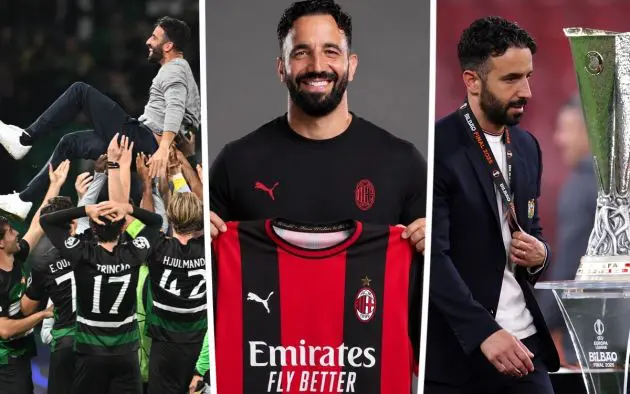
There is a peculiar kind of optimism that accompanies every new appointment at AC Milan. The quiet faith of a fanbase conditioned by broken promises, one that has learned, painfully, to temper expectation with scepticism.
Read SempreMilan ad-free and get access to exclusive news. Click here for a free trial!
And yet, every summer, the cycle begins again. A new name, a new vision, a new dawn. This summer, that name is Rúben Amorim. The Portuguese coach arrives at Milanello carrying two very different CVs, depending on which version of him you choose to believe in.
The first is the coach who walked into Sporting CP in March 2020 and transformed a club hollowed out by a 19-year title drought. In his first full season, Sporting won 26 games, drew seven, and lost just once. They conceded only 20 goals in the league – the finest defensive record in Europe that year – and delivered a Primeira Liga title that the club had feared might never come again.
Over four years in Lisbon, Amorim claimed five major honours: two league titles, three League Cups, and a Super Cup. He dismantled Champions League opponents with ruthless efficiency, becoming the most successful Sporting coach in the history of the competition.
His final home game ended with Sporting beating Manchester City 4–1, his players lifting him off the ground in celebration. The second CV belongs to the man who arrived at Old Trafford in November 2024 in a blaze of fanfare, paid for with a €10m release clause, and proceeded to oversee one of the most wretched chapters in Manchester United’s modern history.
His debut Premier League season ended in 15th place, having lost 14 of 27 league games that he oversaw. A run to the Europa League final in Bilbao offered a fleeting suggestion of redemption, but even that ended in defeat. The second season brought marginal improvement before the wheels came off entirely. In his final months, United managed just three wins in eleven games.
The conclusion of this painful chapter arrived on January 5, 2026, the morning after a chaotic press conference in which Amorim publicly lashed out at director of football Jason Wilcox and the scouting department, demanding they “do their job.” He had already lost the dressing room; the board simply followed.
His final numbers at United were damning: 24 wins from 63 games, a win rate of 38.1%, the worst of any permanent manager since Sir Alex Ferguson’s retirement. He lost a third of his matches; a record that, among permanent appointees, had not been matched since Frank O’Farrell in the early 1970s.
Amorim fell out with prominent players at United, such as Marcus Rashford, who was eventually shipped to Aston Villa and then Barcelona, and with Alejandro Garnacho, who departed for Chelsea after a very public dispute over his exclusion from the Europa League final.
Rasmus Højlund was dropped and marginalised. Kobbie Mainoo, arguably the most exciting academy graduate the club had produced in a decade, was rendered peripheral and reportedly grew open to leaving. Even Lisandro Martínez, one of United’s most dependable performers, reportedly clashed with Amorim in a furious training ground confrontation in the coach’s final weeks at the club.
What went wrong?
The diagnosis was consistent: a coach of genuine intelligence and a coherent tactical philosophy, entirely unable (or unwilling) to adapt it to the personnel available to him.
The 3-4-2-1 system was not simply a preference. It was a doctrine. Players who could not implement it were discarded, regardless of quality. And when results deteriorated, the system remained. Immovable, immutable, and stubborn until the very end.
It is this quality – the dogmatic, almost theological attachment to a singular idea – that draws uncomfortable comparisons with a more familiar figure in the Via Aldo Rossi. Amorim represents, in temperament and tendency, the same obstinate rigidity that Massimiliano Allegri brought to Milanello.
Allegri, too, presided over a side built for a version of football the game had moved beyond. He, too, refused to evolve. The result, as outlined in the wreckage of the 2025–26 season, was a collapse that cost the club a top-four finish, and Allegri his job.
That Milan’s new ownership should look at this picture and land on Rúben Amorim requires some explaining. In fairness, the alternatives were not without their complications. Matthias Jaissle was possibly priced out by a prohibitive release clause and salary demands.
Oliver Glasner possesses an enviable trophy cabinet, including an FA Cup and a Conference League, but his acrimonious departure from Crystal Palace leaves a question mark over his suitability for a dressing room and a frigid ownership that requires careful management.

Rolling the dice
Milan’s preference for company men perhaps made Glasner a complicated proposition. Amorim, evidently, was judged to be worth the risk.
Whether that risk is rewarded will depend almost entirely on which Rúben Amorim reports to Milanello. The Sporting version was exceptional: a meticulous builder, a defensive innovator, a coach who shaped a squad in his image from the very first training session.
The United version was a cautionary tale about what happens when a coach with a fixed system meets a squad that does not fit it, and mistakes rigidity for conviction.
Milan are betting, presumably with some intelligence behind the decision, that the conditions here more closely resemble Lisbon than Manchester. A squad in the process of being rebuilt, a fresh start.
Amorim may well be the right choice. Or this may be another expensive lesson in the difference between potential and fit. After several reboots and years of shattered expectations, Milan supporters have learned to wait before celebrating.
The question is not whether Amorim can coach. The question is whether he can adapt. At United, the answer was no. At Milanello, it remains to be seen, but he will at least fulfil a propechy.