
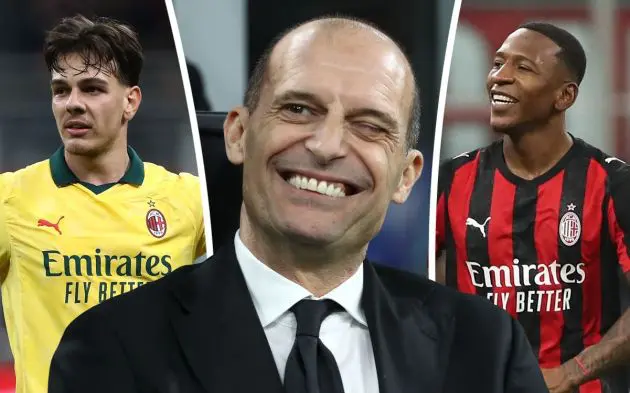
Sunday’s derby win over Inter is followed by an even more important trip to face Lazio, and Massimiliano Allegri has some big calls to make.
Read SempreMilan ad-free and get access to exclusive news. Click here for a free trial!
Beating Inter last weekend was absolutely crucial in keeping the door even slightly ajar with regards to the title race. The Nerazzurri remain the overwhelming favourites, but Milan did their job by securing a league derby double for the first time since 2010-11, cutting the gap from 10 to seven points.
The hero on the night was a rather unlikely one in Pervis Estupinan, who wasn’t certain to be starting the game until just before, with the hope being that Davide Bartesaghi would recover. He was teed up by Youssouf Fofana who – like the Ecuadorian – had been the subject of widespread criticism.
So, with no further missteps allowed in the final 10 games, especially if Inter were to drop points on Saturday night, Allegri has some dilemmas to ponder.
The hot boot fallacy?
To adapt a term from basketball, the hot hand fallacy is the “false belief that a person experiencing a streak of success (e.g., scoring in basketball) is more likely to succeed again, ignoring that the events are often independent. It stems from mistakenly perceiving small, random, short-term streaks as representative of long-term performance.”
How might this apply to football? Well, to simplify, just because Estupinan had a big moment and a solid performance against Inter does not necessarily mean that he automatically jumps above Bartesaghi in terms of credit in the bank.
In this case, the temptation is very obvious: to keep faith in a player that has come through a bit of hardship in his first Serie A season and now must be riding the crest of a wave after experiencing a night that even made his own mother cry back in South America.

There is more to it than the psychological though, too. Of course Allegri will be thinking about the tactical element and whether Estupinan might be able to get in behind the attack-minded Adam Marusic, just as his speed was used to exploit Luis Henrique’s lapse in judgement on Sunday.
Then there is the physical aspect as well: Bartesaghi limped off against Cremonese with what looked at first to be quite a bad groin issue. Thankfully a tear or anything severe was ruled out, but he wasn’t risked against Inter, and perhaps giving him one more game off wouldn’t be the worst idea either.
There is a big call to make in midfield, and here we find the first indication that Allegri does not fall victim to the aforementioned fallacy. When Ardon Jashari stole the show against Como at home, many presumed it would be the first in a run of many starts, even with Adrien Rabiot back.
The Swiss midfielder had 97% pass completion, 3 chances created, 10 passes into final third, 6/6 on long balls, 4 recoveries, 2 tackles and 1 gorgeous assist in that game against Como. He started the next game against Parma but came off after 74 minutes.
Since then, Jashari has not played a single minute across the two games that have followed, which has surprised many. From this, we can deduce that Allegri doesn’t tend to roll with players through recency bias, and instead firmly stick with his prior convictions.
Another example of this has been on the right side. When Alexis Saelemaekers was sidelined briefly, Zachary Athekame stepped up to the plate and did well, even being involved in two goals away from home against Bologna and Pisa (one a pre-assist, the other an assist). Once the Belgian was back, he was immediately reinstated.
Fofana’s situation in the past 10 games has been paradoxical. His minutes are as follows: 27 vs. Fiorentina away, 70 vs. Como away, zero vs. Lecce at home, zero vs. Roma away, 90 vs. Bologna away, 72 vs. Pisa away, 34 vs. Como at home, 0 vs. Parma at home, 62 vs. Cremonese away and 72 vs. Inter at home.
It seems to be either feast or famine for the Frenchman in terms of starts and game time. Strangely, Allegri has often preferred to field him against low-block sides where a more creative midfielder might be better than a combative one, but then by the same token Fofana has the joint-most assists since the start of last season with 13.
Finally, there is Christopher Nkunku. He ended 2025 by getting his first goal (a brace in fact) in Serie A against Verona, and by February 3 he was on five, after netting important goals against Fiorentina, Como and Bologna.
Since that goal in Bologna, Nkunku has been taken off at half-time in Pisa, played 62 minutes against Como, then five against Parma, 12 against Cremonese and six against Inter. In other words, he has recently become an afterthought again, even when Rafael Leao and Christian Pulisic have clearly been struggling physically.
What can we deduce from the above? While there might be a swell of fan and media opinion towards an ‘in-form’ player starting (and we use that term loosely with Estupinan), Allegri doesn’t listen and always fields the team that he thinks is best.
Given the transformation in results under the former Juventus manager, it feels hard to argue against his methods. The dipping in and out of various players might not do them too much good in terms of consistency and continuity, yet it perhaps also arguably keeps them sharp and protected to an extent.
Every single round of Serie A action is a fact-finding mission for Massimiliano Allegri as he begins to think about who can form a key part of his squad for 2026-27 and beyond. He has gotten some positive answers from those he perhaps didn’t expect to, with 16 of the 20 outfield players having scored this season.
However, as the number of games remaining reduces and the runway shortens, the room for experimentation and sentimentality decreases. Allegri has more of an idea of his formula now than he ever has done, and this clarity of thought has proven to be an asset.