
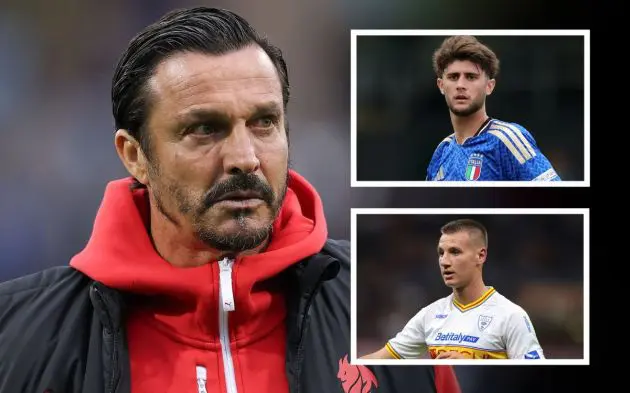
Massimo Oddo has shed some light on his decision to leave Milan Futuro, commenting on the futures of several young talents too.
Read SempreMilan ad-free and get access to exclusive news. Click here for a free trial!
After the play-off defeat to Chievo Verona sealed Serie D status for another year, it was announced that Milan would be parting ways with Oddo. It wasn’t a sacking but rather a mutual decision, with the coach hoping to test himself at a higher level.
As soon as Oddo left the club reports emerged suggesting the Rossoneri might go for a non-Italian coach, to remain consistent with the new vision under Ruben Amorim. Sergio Navarro is the man who came in, and we published a breakdown of his tactical approach after the announcement.
Odoo is yet to join another club, but La Gazzetta dello Sport suggest that he is more likely to try something abroad than to take the reins of a club in Italy. The paper conducted an interview with him in which he lifted the lid on various aspects of his past, present and future.
What is your ambition?
“I definitely feel like a coach, so I want to get back to coaching at a high level, doing so consistently. Something that hasn’t happened much lately due to various circumstances.”
Define ‘high levels’…
“I started off very strong, I won Serie B and coached in Serie A. Most of my career was in Serie B. Let’s say I’d like to settle between Serie A and Serie B. Then there was a downsizing, due to bad decisions and bad timing.
“I’d like to embrace a project that allows me to work from the start because in recent years I’ve always been a substitute, and those situations were almost disastrous. And when it’s like that, you depend on too many factors, not just those on the pitch.
“I’d like a team that I can build from the start: when you take over, there’s only the obsession with the result.”
Is there something cooking?
“Not at the moment. Let’s wait.”
What’s the first adjective that comes to mind to describe your recent experience with Milan Futuro?
“I’m happy with what I’ve done. I’m happy to have improved the players; I’ve seen a positive development. Several of them will start with the first team this year. From the outside, it was clear that we had to win Serie D, but that wasn’t the case at all.
“I was never asked to do that, and in any case, it was an almost unattainable goal: we played with an average age of 18-19, we’re talking about a complex category. And then there were players who came and went between the first team and the Primavera, you have to adapt to everyone’s needs.
“Our only goal was to improve the young players, and you had to do it with the ones you had at the time. Basically, they were never the same, so the biggest challenge was building a group. But I wouldn’t call it a limitation; it’s something that’s part of the project.”
Even with Milan Futuro you arrived during the season…
“When I arrived, my only goal was to save the team. I was probably called a little too late: since I took over, we were projected to be in the playoff zone in terms of average points.
“That said, I didn’t want to coach in Serie D: it was Milan who convinced me because they thought I was the right person to lead these guys. I stayed willingly, with the intention of helping them grow and taking them to Serie C.
“That didn’t happen, and I didn’t feel like doing another year in Serie D, which isn’t for me. I left a year on my contract, without asking for a penny, because for me the most important thing is to be motivated at work. It was absolutely my choice.”
So if they had been promoted, you would have stayed?
“In Serie C it would have been different because I would have brought up to a higher division guys I’d already trained and whose improvements I knew. Guys who, moreover, most likely won’t stay in Serie D.”

You were replaced by Spaniard Sergio Navarro: could a foreign coach make sense in such a particular category?
“The key is to develop young players, and he’s been responsible for important youth development programs. Nationality has nothing to do with it.”
What does it mean to have growth as a primary goal?
“For example, sometimes improving players means sacrificing results. You need to prioritize the young players who need to learn the ropes, not the older ones who you already know will make fewer mistakes and might even help you win the match.”
It’s been a summer where fans are talking a lot about Zlatan Ibrahimovic, how involved is he in the project?
“I’ve seen him very little on the pitch, but he doesn’t have a coaching role at Milan. He’s part of the ownership, right? I know he’s very interested in the second team, he watched every game, even if it wasn’t live.
“He gave some principles, perhaps on some tactical aspects, but he didn’t actually have a say in anything. The real culprit is Kirovski.”
There has been quite a bit of talk about him in recent weeks too…
“He’s a manager who cares deeply about young players. He knows a thing or two about them. He paid a heavy price for playing in a league he wasn’t familiar with, and many things went wrong as a result.
“His message has always been to improve the players, not to win. The path of the AC Milan U23s shouldn’t be the same as the first team.”
What are the main differences between Serie C and D ?
“Division D is a very formative category. If anything, the biggest limitation is the pitches. We’ve won most of the games we’ve played on good pitches. And vice versa. The reason is clear: on good pitches, where you could play with two touches, our technical superiority came to the fore.
“On poor pitches, with the fourth touch they’d jump on you, and you’d pay a heavy price physically. But for me, the issue goes beyond Milan, Inter, or Juve. It’s broader.”
That is to say?
“Barcelona and Bayern also have second teams in the fourth tier, but with a substantial difference: their football philosophy starts when they’re eight years old and they carry it forward with a fixed and progressive technical-tactical idea to provide the kids with a unique philosophy regardless of age or category.
“And then there’s another big difference: there, the best players debut in the fourth tier at 14 or 15, and in the first team at 18. Here, we celebrate if an 18-year-old debuts in the Serie D. It’s late. The madness is that you can stay in the Primavera until you’re 20.
“I know kids with over a hundred Primavera appearances, because maybe you have to win the championship or play in the Youth League: what’s the point? How do you improve?
“The way I see it, the idea is very simple: I have a good kid? I move him up a category, I send him under age, I increase the difficulty coefficient. That way you improve, that way you take him forward.”
The Mattia Liberali case: first let go, then an attempt to bring him back…
“Losing a player is normal; some players explode sooner, others later. It’s a matter of misjudgment. I myself spent several years on loan around Italy, and when I exploded in Naples, Milan sold me to Verona.
“I thought I’d return to the Rossoneri. After five years, they bought me back for triple the price. The basic problem with these guys is the paths they’re forced to follow. Most of the time, they’re the wrong ones.
“Liberali was playing in the second team last year, made his debut in the first team, and then found himself in the Primavera. You have to understand that these are kids; imagine being inside that kid’s head; these are complicated situations to manage.”
Speaking of routes, then: let’s talk about what you think would be best for Camarda…
“Francesco should do what he should have done a year ago: he’ll definitely get to Serie A, but now he needs consistency, for example by joining a top-tier Serie B team that plays to win. Last year he called me to ask what I thought of Lecce, and I told him he’d made a mistake.
“I asked him why he was in such a hurry, at his age, to get straight to Serie A. I told him he needed consistency, and that to find it, he needed to lower his level. Di Francesco is excellent, but Lecce plays to stay up, mostly playing in their own half, and that’s tough for a striker.”
How do you assess the situation of the first team, which has gone from the disappointment of late May to Cardinale’s revolution?
“No one expected such a disappointment, including me. I’ve been in contact with Allegri all year, I watched every training session, he’s a good coach, and it was a healthy group.
“A group that worked well. Then at a certain point something broke, but not during the week. Maybe it was the fear of not reaching the finish line.”
Are you sorry that Allegri’s cycle ended so soon?
“I think he did a great job. I feel sorry for him, but I’m happy that Milan has rediscovered its enthusiasm. Ultimately, I always say one thing: you can hire the best coaches in the world, but if they don’t get support, it’s tough for anyone. I hope there’s unity of purpose within the club now.”